
Before you create more content, ask these three questions.

There is no shortage of advice telling business owners what content they should be creating.
Start a podcast.
Build a YouTube channel.
Post more often on Instagram.
Get serious about LinkedIn.
Send a weekly email.
Create short-form video.
And none of that advice is necessarily wrong.
The problem is that we often start with the format or platform before we’ve worked out what the content is actually supposed to achieve.
Before deciding what to create next, there are three questions worth answering:
What is it for?
Who is it for?
Why are you creating it?

Not every business needs every platform
Take podcasting.
A podcast can be an incredibly valuable business asset. It can build authority, deepen relationships, create a library of long-form ideas and conversations and generate material that can be repurposed in dozens of ways.
But that doesn’t automatically mean your business needs one.
Are the people you want to reach listening to podcasts?
Do you have enough to say?
Does audio suit the way you naturally communicate?
Does it support a broader business objective?
Can you realistically keep producing it?
The same questions apply to YouTube, Instagram, TikTok, LinkedIn or email.
The fact that a platform exists, or that someone has told you it’s where businesses “need to be” – isn’t enough reason to devote hours of your week to it.
Find the overlap between your audience and you
There are two sides to this.
First: where are your people?
Where do your current clients spend time?
What platforms do they use professionally?
What do they watch, listen to or read?
How do they discover new businesses?
What kind of content makes them stop and pay attention?
Second: how do you communicate best?
Some people come alive in conversation.
Some are excellent writers.
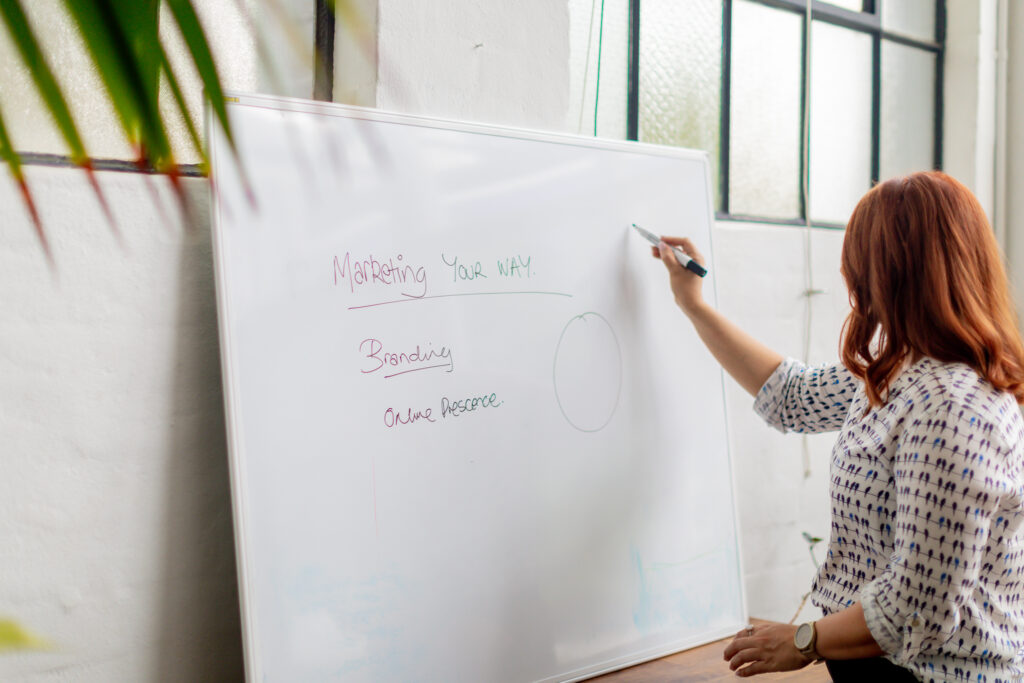
Some can explain an idea brilliantly when they’re standing at a whiteboard.
Some naturally tell stories.
Some are wonderful interviewers.
Some would rather crawl under their desk than speak directly to a camera.
You don’t have to force yourself into somebody else’s content model.
The interesting bit is finding the overlap between the way you communicate well and the way your audience likes to consume information.
Your clients are an excellent source of content research
We can become so focused on analytics, trends and algorithms that we forget we have access to something considerably more useful:
Actual human beings who have already chosen to work with us.
Talk to your current and past clients.
You could ask:
- Where do you spend most of your time online?
- What kind of business content do you actually enjoy?
- Do you listen to podcasts?
- Do you read email newsletters?
- Do you use LinkedIn regularly?
- Do you search YouTube when you want to learn something?
- How did you originally come across my business?
- What made you continue paying attention?
You don’t need a giant formal research project.
Even five or ten conversations could uncover patterns you hadn’t considered.

More content isn’t always the answer
I think this is where a lot of content burnout begins.
Business owners are trying to maintain Instagram, TikTok, LinkedIn, Facebook, YouTube, Pinterest, email and possibly a podcast at the same time — while also running the business that all this content is supposedly there to support.
Of course it becomes exhausting.
And when content creation starts feeling like an endless machine that simply needs feeding, it’s very easy to stop altogether.
The answer may not be to create more.
It might be to create less, more deliberately.
One strong idea could become a video, an email, a LinkedIn post and a useful article.
A client conversation could spark three months of questions worth answering.
A long-form podcast or video could become the source material for shorter pieces.
Rather than asking:
“How do I keep up with all these platforms?”
Try asking:
“What does my business need people to understand right now, and what is the best way to communicate that?”
That’s a very different way to approach content.
And usually, a much more sustainable one.